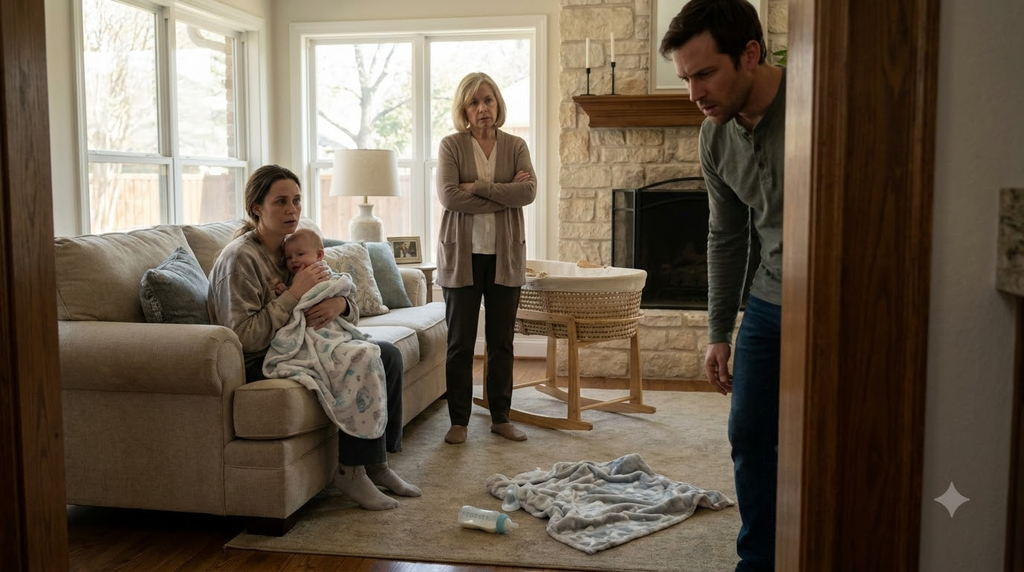
I stared at that drawer as if it had started breathing.
Ryan followed my eyes, and for the first time since he came home, the anger drained from his face. It was replaced by something worse. Fear.
“Sarah,” he said quietly, “don’t.”
That single word told me everything.
Noah was still crying against my chest, his wet hair sticking to his forehead, his tiny hands trembling against my shirt. I looked down at him, then back at my husband.
“You knew,” I whispered.
Ryan swallowed. “It wasn’t like this.”
Linda wiped her tears too fast. “Ryan, tell her she’s being unstable.”
But Ryan didn’t defend her. He didn’t even look at her. His eyes stayed on me, pleading now, as if the real victim in the room was the secret he had failed to keep buried.
I shifted Noah higher in my arms. “Open it.”
“No.”
That was all I needed.
I walked past him, grabbed the brass lamp from the side table, and brought it down hard against the drawer lock. The first strike cracked the wood. The second split it open.
Ryan lunged forward. “Sarah, stop!”
But he was too late.
Inside were papers. Old medical reports. A faded photograph of a baby with formula dried in her hair. A hospital discharge form. A social services warning. And a handwritten letter signed by Linda herself, promising she would never be left alone with an infant again.
My knees almost gave out.
The baby in the photo was Ryan’s younger sister, Emily.
The sister he had always told me died from “breathing complications” before she was six months old.
I looked at Ryan.
He was crying silently.
“You let her move into our house,” I said. “You let her touch our son.”
“I thought she had changed,” he whispered.
Linda suddenly screamed, “That was thirty years ago! They blamed me for everything! I was young! I was tired!”
Noah whimpered in my arms.
I turned to her slowly.
“He is three months old.”
For once, Linda had no answer.
I took pictures of everything. The reports. The letter. The broken drawer. Noah’s soaked blanket. His milk-covered face. Linda’s bottle still lying on the floor. Then I called 911.
Ryan tried to stop me.
Not by grabbing me. He knew better by then. He just stood in front of the door and begged.
“Sarah, please. Think about our family.”
I looked at Noah.
“I am.”
The ambulance came first. Then the police.
Linda performed beautifully. She sobbed. She shook. She pressed one hand to her cheek and told them I had attacked her for no reason.
Then one officer looked at Noah’s blanket.
Another looked at the papers spread across the floor.
And Ryan, finally cornered by the truth, lowered his head and said, “My mother did this before.”
That was the moment Linda’s face changed.
Not sad.
Not sorry.
Angry.
Pure, ugly anger.
She looked at her own son like he had betrayed her by refusing to lie.
“You weak little boy,” she hissed. “I protected you your whole life.”
Ryan looked up at her.
“No,” he said. “You trained me to be afraid of you.”
At the hospital, they checked Noah carefully. He was shaken, cold, and terrified, but safe. I held him against me the entire night. Ryan sat in the hallway because I would not let him into the room.
By morning, I had filed the police report.
By noon, I had called a lawyer.
By evening, Ryan’s family group chat had received one message from me: a photo of Linda’s signed promise, the old report about Emily, and Noah’s soaked blanket.
No explanation.
None was needed.
Linda lost everything faster than she could invent a new version of herself.
Her church committee asked her to step down. Her friends stopped answering. The women who had once called her “strict but loving” suddenly remembered stories they had ignored for years. The cousin who had been told never to leave her newborn with Linda finally called me, crying, saying she wished she had trusted her instincts sooner.
Ryan begged me not to divorce him.
He said he loved Noah.
He said he loved me.
He said he had been ashamed, terrified, manipulated.
Maybe all of that was true.
But love does not hide a locked drawer from a mother and place her baby in danger to avoid an uncomfortable truth.
In court, Linda wore pearls.
She smiled softly at the judge.
She said I was emotional, unstable, sleep-deprived, and violent.
Then my lawyer placed the old documents on the table.
The room went quiet.
Then came the pediatric notes.
Then the social services warning.
Then the signed promise.
Then Ryan’s statement.
Finally, the judge saw the photograph of Noah wrapped in that milk-soaked blanket, his tiny face red from screaming.
Linda stopped smiling.
The restraining order was granted.
Ryan received supervised visitation only, not because he poured the milk, but because he knew enough to protect Noah and chose silence instead.
As for Linda, the punishment that destroyed her was not the legal one.
It was the truth.
For thirty years, she had lived inside a polished lie. A grieving mother. A misunderstood woman. A victim of rumors.
I took that lie from her.
I did not shout outside her house. I did not chase her. I did not need to.
I gave the truth to the people who had helped her bury it.
And I watched them step away.
One by one.
A month later, I returned to the house with my lawyer and two officers to collect the rest of my things. Ryan was there, thinner, hollow-eyed, holding an envelope.
“I found something else,” he said.
I did not take it.
“What is it?”
His hand shook.
“Emily’s death certificate was amended before the funeral. My father signed something. My mother wasn’t the only one who knew.”
The house went silent around us.
I looked at the envelope.
Then at the hallway where the broken drawer still hung open.
And for the first time, I understood that Linda’s secret had not ended with her.
It had only started there.
